The fastest way to tell if a piece of Wedgwood is 250 years old or 25? Flip it over.
The marks on the bottom of Wedgwood pottery have changed more than a dozen times since Josiah Wedgwood opened his first workshop in Burslem in 1759. Each change corresponds to a specific period — a partnership, a factory move, a trade law, a corporate merger. If you know what to look for, a single glance at the base of a plate can narrow the date to within a decade. Sometimes to a single year.
That matters because the difference between early and late Wedgwood is enormous. An 18th-century Portland Vase replica sold for roughly $614,000 at auction (Potteries Auctions, 2024). A 20th-century version of the same form? A few hundred pounds. The mark is where you start.
This guide walks through every major Wedgwood mark from the company’s founding to the present day. We’ll cover the early hand-impressed stamps, the three-letter date codes that let you pinpoint a year between 1860 and 1929, and the trade-law shortcuts that make post-1891 pieces easy to date. We’ll also cover the fakes — because there are plenty of them.
Key Takeaways
• “ENGLAND” on a Wedgwood mark means post-1891 (McKinley Tariff Act). “MADE IN ENGLAND” means post-1908.
• Three-letter date codes (1860–1929) let you identify the exact year of production — see the decoder table below.
• Authentic Wedgwood never spells the name “Wedgewood” with an extra ‘e.’
• Jasperware auction prices range from £80 for common pieces to over £100,000 for museum-quality rarities (Fine Art Restoration Co., 2023).
Why do Wedgwood marks matter for collectors?
Wedgwood jasperware recently sold at auction for anywhere from £80 to over £4,000, depending on age, rarity, and condition (Potteries Auctions, 2024). The mark on the base is the single fastest way to sort a £40 trinket from a £4,000 collector’s piece. Without reading the mark correctly, you’re guessing — and guessing is how people overpay for reproductions or undersell genuine antiques at estate sales.
Wedgwood is also one of the most consistently marked potteries in history. Josiah Wedgwood began stamping his wares almost from the start, which is unusual for 18th-century makers. That means authentic unmarked Wedgwood is rare. If a piece has no mark at all but someone insists it’s Wedgwood, be skeptical.
The global collectibles market reached $320.3 billion in 2025 and is projected to hit $535.5 billion by 2033 (Grand View Research, 2025). Ceramics are a meaningful slice of that. Over 10,000 Wedgwood auction results are catalogued on LiveAuctioneers alone. Knowing what you’re looking at is the difference between collecting and gambling.

How were early Wedgwood pieces marked (1759–1780)?
The earliest Wedgwood marks were hand-impressed into the wet clay using individual printer’s type, one letter at a time (Antique Marks, 2024). That’s why pre-1769 marks look uneven — slightly arced, inconsistently spaced, sometimes with letters at different depths. If the “WEDGWOOD” stamp on your piece looks machine-perfect, it’s not from this era.
Josiah Wedgwood worked at the Ivy House and Bell Works in Burslem from 1759 to 1769. Marks from this period are simply “WEDGWOOD” in uppercase, pressed into the body before firing. Some very early pieces may have a crude “W” alone, though these are exceptionally rare and difficult to authenticate.
The Wedgwood & Bentley years (1769–1780). In 1769, Josiah partnered with the Liverpool merchant Thomas Bentley and opened the Etruria factory in Stoke-on-Trent. Ornamental wares from this period carry several distinctive marks:
- “Wedgwood & Bentley” — impressed in a straight line or arranged in a circle around the word “Etruria”
- “W & B” — found on very small items like intaglios and cameos where the full name wouldn’t fit
- Catalogue numbers (e.g., “356”) on ornamental pieces, referring to Wedgwood’s own numbering system
Bentley died in 1780, and the partnership marks stopped immediately. Any piece marked “Wedgwood & Bentley” dates to that eleven-year window — no exceptions. These are among the most sought-after Wedgwood marks.

What changed after the partnership ended (1780–1860)?
After Bentley’s death, Wedgwood marks reverted to “WEDGWOOD” alone — now impressed from a single slug rather than individual letters, so the spacing is more uniform than pre-1769 marks (Collecting Wedgwood, 2024). This is the standard impressed mark that most collectors associate with “classic” Wedgwood, and it stayed in use for the better part of a century.
A few important variants appear during this stretch:
“Wedgwood & Sons” (c. 1790). Used very briefly when Josiah’s sons joined the firm. Rare enough that some reference books dispute whether it was a production mark at all or just appeared on internal documents.
Bone china marks (1812–1822). Wedgwood experimented with bone china for about a decade. These pieces carry printed marks in red or blue rather than the usual impressed stamp — the only time in the company’s first century that printed marks were the primary identifier. If you find a Wedgwood piece with a printed coloured mark and no impressed stamp, bone china is the likely period.
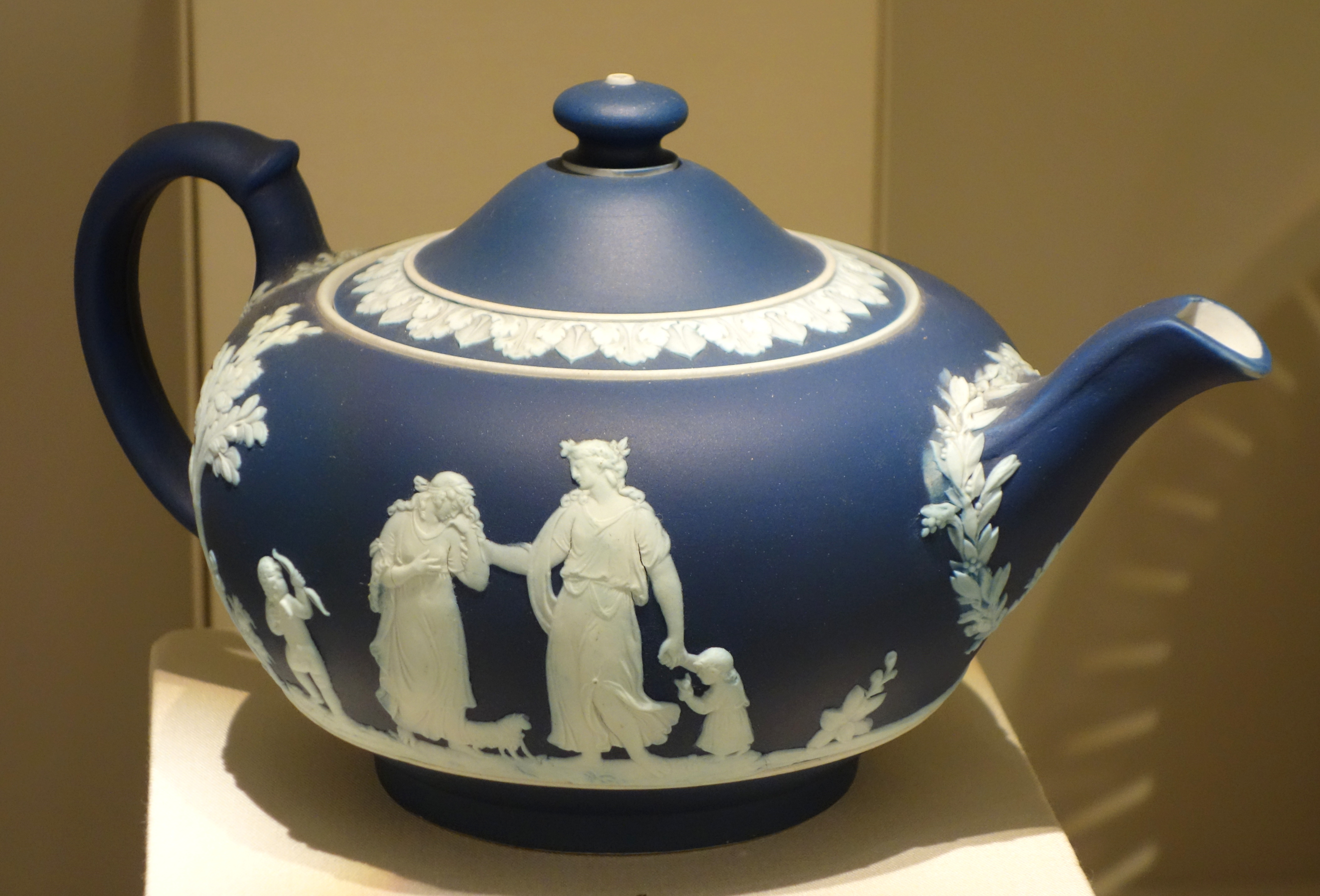
Jasperware refinements. Josiah developed jasperware in 1774, and by the 1780s the factory was producing both “solid” jasper (colour running through the entire body) and “dip” jasper (a white body washed with colour). Solid jasper is generally earlier and more valuable. The mark itself doesn’t distinguish between solid and dip, but you can check by looking at the unglazed edge or any chip — if it’s white underneath, it’s a dip piece.
How do the three-letter date codes work (1860–1929)?
Starting in 1860, Wedgwood added a three-letter code to each piece that tells you the month, the individual potter, and the year of production (The Potteries). This is the most precise dating tool in the Wedgwood collector’s toolkit — no other English pottery of this era gives you the exact year so directly. If your piece has three small impressed letters near the main “WEDGWOOD” stamp, here’s how to read them.
The first letter is the month:
| Month | Letter (1860–1863) | Letter (1864 onward) |
|---|---|---|
| January | J | J |
| February | F | F |
| March | M | R |
| April | A | A |
| May | Y | M |
| June | T | T |
| July | V | L |
| August | W | W |
| September | S | S |
| October | O | O |
| November | N | N |
| December | D | D |
The second letter identifies the potter who made the piece. This is useful for factory records but less helpful for dating, since the same potter could work for decades. Skip it for dating purposes.
The third letter is the year. This is the one that matters. Wedgwood used three cycles of letters, starting at different points in the alphabet:
How to resolve ambiguity. Since cycles 2 and 3 both start at “A,” the third letter alone doesn’t tell you whether your piece is from 1872 or 1898. But there’s a built-in cheat: if the piece also says “ENGLAND,” it’s post-1891, which rules out most of cycle 2. And from 1907, the month letter was replaced by the numeral “3,” and from 1924, a “4” prefix appeared for the fourth cycle’s marks. These small shifts make the system more precise than it looks at first glance.
What does “ENGLAND” on Wedgwood mean?
The word “ENGLAND” on any Wedgwood piece means it was made after March 1, 1891. That’s the date the McKinley Tariff Act took effect in the United States, requiring all imported goods to be marked with their country of origin in legible English (Gotheborg). This is the single most useful dating shortcut in British ceramics — not just for Wedgwood, but for any English pottery.
Here’s the sequence:
- No country mark — pre-1891
- “ENGLAND” — 1891 onward (for export to the U.S.; some domestic pieces also received it)
- “MADE IN ENGLAND” — c. 1908 onward (the fuller phrase became standard in the early 20th century)
One caveat: “ENGLAND” was required on pieces exported to the U.S. Some Wedgwood made for the domestic British market in the 1890s may lack it. But if a piece does have it, the date floor is firm. It can’t be earlier than 1891.

How do you read 20th-century Wedgwood marks?
The 20th century brought more changes to Wedgwood marks than any other period, with the company updating its backstamp roughly every two decades (Antique Marks, 2024). Here’s the sequence:
Portland Vase backstamp (1878 onward). A printed image of the Portland Vase appears on backstamps starting in the late 1870s. This was used alongside the impressed “WEDGWOOD” mark, not as a replacement. If you see the vase image without an impressed mark, examine the piece carefully — it may be a later reproduction or a different maker entirely.
Three stars below the vase (c. 1900). Around 1900, three stars were added beneath the Portland Vase image, and “MADE IN ENGLAND” was incorporated into the printed mark.
Numeric year codes (1929 onward). When the three-letter date code system ended in 1929, Wedgwood switched to stamping the last two digits of the year directly. A piece marked “30” was made in 1930; “52” in 1952, and so on. Much simpler than the letter codes.
Pattern names on backstamps (1962 onward). From 1962, the name of the pattern (e.g., “Countryside,” “Wild Strawberry”) began appearing as part of the printed backstamp, along with a line at the bottom of the mark. If your piece has a named pattern printed on the base, it’s post-1962.
Portland Vase inside the “W” (1998 onward). In a mid-1998 redesign, the Portland Vase image was incorporated within the letter “W” of the Wedgwood name. This is the modern mark you’ll find on current production.
What happened to Wedgwood marks after 2009?
Waterford Wedgwood plc entered receivership on January 5, 2009, ending the company’s 250-year run as an independent business (Wikipedia). KPS Capital Partners acquired the assets and created WWRD Holdings — Waterford Wedgwood Royal Doulton. Then in July 2015, Finland’s Fiskars Corporation bought WWRD for $437 million (Fiskars Group, 2015).
What does this mean for marks? The Wedgwood name and Portland Vase backstamp continue under Fiskars. But there’s a complication collectors should know about.
The Indonesia question. Between 2006 and 2008, some Wedgwood production moved to a factory in Jakarta, Indonesia, which at its peak employed 1,500 people producing 5–7 million pieces annually (Wikipedia). Some of these pieces were marked “Wedgwood England” despite being manufactured overseas — a practice that drew criticism from collectors and Staffordshire potters alike. When buying modern Wedgwood, check for additional backstamp details that may indicate the production location.
The Barlaston factory in Staffordshire — built between 1938 and 1940 to a design by the architect Keith Murray — remains in operation for select production lines. In 1995, the company was granted a Royal Warrant from Queen Elizabeth II. Pieces with the Royal Warrant mark date from 1995 onward.

How do you spot fake Wedgwood?
The most common red flag is the simplest one: spelling. Authentic Wedgwood has never — in over 265 years — spelled the name “Wedgewood” with an extra ‘e’ (The Potteries). If your piece says “Wedgewood,” it wasn’t made at the Wedgwood factory.
There is one exception. A separate potter named John Wedge Wood worked in Burslem (1841–1844) and Tunstall (1845–1860) and legitimately marked his wares “WEDGE WOOD” or “WEDGEWOOD.” His blue-and-white earthenware has modest collector value on its own merits. But it’s not Josiah Wedgwood, and no one should be paying Josiah Wedgwood prices for it.
Physical tells to check:
- Relief decoration. On genuine jasperware, the white figures are applied relief — raised above the surface, individually modelled. Fakes often have flat, painted-on decoration or moulded relief that lacks crisp detail.
- Surface finish. Authentic jasperware has an unglazed matte “biscuit” finish. If the surface is glossy, it’s not Wedgwood jasperware. (Wedgwood did produce glazed wares — Queen’s Ware, bone china — but those aren’t jasperware.)
- Weight and density. Jasperware contains roughly 57% barium sulphate, which gives it a distinctive heft. Pieces that feel too light for their size may be imitations in ordinary stoneware.
- Mark depth and consistency. Early impressed marks vary in depth and alignment. A perfectly uniform, machine-sharp “WEDGWOOD” on a piece claiming to be 18th century is a red flag.
Known imitators. Several 18th-century potters produced jasperware in the Wedgwood style. William Adams (Greengates Pottery, 1779–1805) made jasperware marked “Adams & Co.” that’s sometimes misattributed. John Turner (1762–1786) produced blue-and-white jasper with a harder feel and a blue that tends slightly greenish compared to Wedgwood’s softer tone. These aren’t fakes — they’re legitimate period competitors — but they shouldn’t carry Wedgwood valuations.
Have a piece you’re unsure about? Circa can photograph the mark and cross-reference it against known patterns to give you a likely identification and date range — a practical first step before consulting a specialist.
Quick reference: Wedgwood dating cheat sheet
If you’re standing in an antique shop and need a fast answer, here’s the condensed version. Work through this list top to bottom:
| What you see | What it means |
|---|---|
| No mark at all | Either very early (pre-1769) or not Wedgwood. Be skeptical. |
| “Wedgwood & Bentley” | 1769–1780. Valuable partnership-era piece. |
| “WEDGWOOD” impressed, no country | Pre-1891. Could be anywhere from 1780s to 1890. |
| Three-letter code near the mark | 1860–1929. Decode the third letter using the chart above. |
| “ENGLAND” | Post-1891 (McKinley Tariff Act). |
| “MADE IN ENGLAND” | Post-1908. |
| Portland Vase image in backstamp | Post-1878. |
| Three stars below the vase | c. 1900 onward. |
| Two-digit number (e.g., “52”) | 1929 onward. The number is the year (52 = 1952). |
| Pattern name printed on base | Post-1962. |
| Portland Vase inside the “W” | Post-1998. Current production mark. |
| “Wedgewood” (extra ‘e’) | Not Josiah Wedgwood. Different maker or fake. |
Video: Dating British ceramics backstamps
David W. Smith OBE — a published author on Stoke-on-Trent pottery — walks through how to read backstamps on British ceramics, including Wedgwood. A good primer if you’re trying to match what you see on a piece in hand to a date range.
Video: Decoding pottery marks for beginners
If you’re new to reading marks on pottery in general — not just Wedgwood — this broader guide covers 10 practical tips for identifying backstamps across British ceramics. Good context for understanding where Wedgwood fits in the wider picture.
Frequently asked questions
How can I tell if my Wedgwood is old or new?
Check for three things in order. First, if the mark says “ENGLAND,” it’s post-1891 (McKinley Tariff Act). If it says “MADE IN ENGLAND,” it’s post-1908. Second, look for a three-letter date code — if present, you can decode the exact year of production between 1860 and 1929. Third, the Portland Vase backstamp only appears after 1878. Pieces with none of these features and a hand-impressed “WEDGWOOD” are likely pre-1860.
Is Wedgwood with an extra ‘e’ (Wedgewood) always fake?
Not always fake, but never Josiah Wedgwood’s factory. A separate potter named John Wedge Wood operated in Burslem (1841–1844) and Tunstall (1845–1860) and legitimately marked his wares “WEDGEWOOD” (Michigan Questers). His blue-and-white earthenware has modest collector value on its own. But anyone selling “Wedgewood” jasperware as genuine Josiah Wedgwood is either mistaken or dishonest.
What is the most valuable type of Wedgwood?
First-edition Portland Vase replicas and 18th-century jasperware command the highest prices. A Wedgwood Portland Vase replica from around 1790 sold for approximately $614,000 at auction (Potteries Auctions, 2024). Rare jasperware colours — lilac, sage green, crimson dip — from the 18th century can reach £4,000 or more. Standard blue-and-white jasperware from the 19th and 20th centuries typically sells between £80 and £700.
How do I decode a three-letter Wedgwood date code?
The three letters represent month, potter, and year — in that order. The first letter is the month (J = January, F = February, R = March from 1864, and so on). The second identifies the potter. The third gives the year within a cycle: O = 1860 through Z = 1871 (cycle 1), A = 1872 through Z = 1897 (cycle 2), A = 1898 through F = 1929 (cycle 3). If the piece also says “ENGLAND,” it’s cycle 2 or 3.
Can an app identify Wedgwood marks?
Yes. AI identification apps like Circa can photograph a mark and cross-reference it against known Wedgwood patterns, returning a likely date range and production era. The global collectibles market reached $320 billion in 2025 (Grand View Research), and digital tools are increasingly part of how collectors authenticate pieces. An app won’t replace a specialist for museum-quality items, but it’s a practical first step for the thousands of Wedgwood pieces that surface at estate sales every year.
Catherine Hartley is a certified appraiser (ISA) and antiques market analyst with 15 years of experience in estate valuation. She has appraised collections for auction houses across the Northeast and writes about authentication and pricing trends for collectors.