
You find the tray at the back of your grandmother’s china cabinet, tarnished nearly black. You turn it over and there, pressed into the metal like tiny punctuation, are four marks. A walking lion. A leopard’s head. The letter Q inside a curly shield. Two initials, HB, in a rectangle.
Those five stamps tell you, with about 98% confidence, that the tray is sterling silver, was made in London in 1770, and was hallmarked by Hester Bateman — one of the most sought-after Georgian silversmiths alive. Without them, the same tray is scrap weight. With them, it’s an heirloom.
Silver hallmarks are the world’s oldest consumer protection system, in continuous use since 1300 (Goldsmiths’ Company, n.d.). They’re also small, badly worn, archaic, and scattered across seven centuries of regional variation. Most collectors never learn to read them, which is a little like owning a rare book and never opening the cover. Here’s how to do it.
Key Takeaways
• British hallmarks have been legally required since 1300, making them the world’s oldest consumer protection system (Goldsmiths’ Company, n.d.).
• A full British hallmark has four or five marks: maker’s, standard (purity), town/assay, date letter, and sometimes a duty mark for items made 1784–1890.
• Sterling silver is 92.5% pure (925/1000); Britannia is 95.84% (958); American coin silver is 90% (900); French 1st standard is 95% (950).
• Silver spot reached $79–$82 per troy ounce in April 2026 (LBMA via SD Bullion, 2026), making accurate hallmark identification more valuable than it’s been in a generation.
• Two UK jewellers were convicted and fined in November 2025 for selling unhallmarked silver (Hull City Council, 2025) — misrepresented silver is a live problem, not a historical one.
Why do silver hallmarks exist at all?
Because in 1300, King Edward I needed a way to stop goldsmiths from selling debased silver as the real thing. His statute required every silver item above a minimum weight to be tested at the Goldsmiths’ Hall in London and, if it passed, struck with a leopard’s head as proof. That mark is still in use today (Goldsmiths’ Company Assay Office, n.d.). The system predates banknotes, predates printing, predates the modern English language.
The modern version is surprisingly unchanged. A British hallmark is still applied at one of four government-sanctioned assay offices (London, Birmingham, Sheffield, Edinburgh) operating under the Hallmarking Act 1973. It’s still a legal offence to sell silver above 7.78 grams without one (Hallmarking Act 1973). The London office alone hallmarks several million items a year; Birmingham processes around three million annually as of 2024 (Birmingham Assay Office, 2024).
The point of hallmarks isn’t decoration. A hallmark tells you, in a handful of stamps smaller than a grain of rice, who made a piece, where it was tested, what it’s made of, when it was struck, and sometimes whether the maker paid their tax. Every major silver-producing country has evolved its own version. Which is why telling the difference between a $2,000 Bateman salver and a $50 Victorian plated tray comes down to recognising about two dozen symbols.
Our rule of thumb, from the counter: if a silver piece has no marks at all, the odds it’s solid silver drop to roughly one in ten. Unmarked vintage silver does exist — studio work, colonial pieces, items worn smooth — but the assumption of every auction cataloguer starts in the same place: no mark means plated, until the metal proves otherwise.
What are the four marks on British silver?
Four marks, sometimes five. Every piece of British silver assayed since 1544 carries a maker’s mark, a standard mark (purity), a town mark (which assay office), and a date letter. From 1784 to 1890, a fifth duty mark — the reigning monarch’s head in profile — was added to show excise had been paid. Together they read like a compressed identity card.
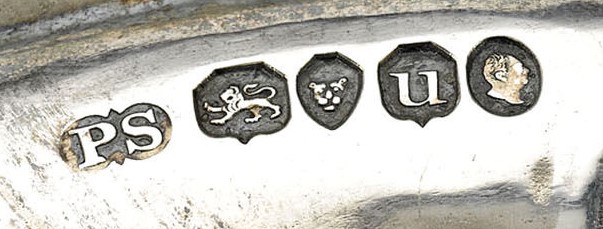
Photo: Rauantiques / Wikimedia Commons / CC BY-SA 4.0
The order isn’t strict and varies by period, but the set is almost always struck in a single horizontal row or a tight cluster on the bottom, back, or inner edge of the piece. On a spoon you’ll find them on the back of the stem near the bowl. On a salver or tray, usually on the underside near the rim. On a teapot, underneath the base or inside the lid. On hollowware, occasionally on the body if there’s no better surface.
What makes British hallmarks so useful is that none of the four stamps are optional. If a British-made piece is missing any one of them, that’s a red flag. Either the piece was never legally hallmarked (likely plated or foreign), the mark has worn off completely (uncommon on genuine sterling, which doesn’t buff out easily), or someone has polished or ground the marks away — a classic sign of either heavy repair or deliberate fraud.
How do you read the town mark?
The town mark tells you which assay office tested the piece, and by extension where it was most likely made. The UK has four active assay offices today, down from six before the closures of Chester (1962) and Glasgow (1964). Each has its own symbol, unchanged for centuries (British Hallmarking Council, n.d.).
A few extras worth recognising. Chester used a sword between three wheat sheaves until it closed in 1962, and Chester-assayed silver (common on Welsh and northwest English pieces) is now a small collector category. Glasgow used a tree, salmon, bell, and bird — closed 1964. Exeter used a three-towered castle similar to Edinburgh’s (closed 1883). And Ireland — not a UK office but historically related — uses Hibernia seated with a harp, struck in Dublin since 1638.
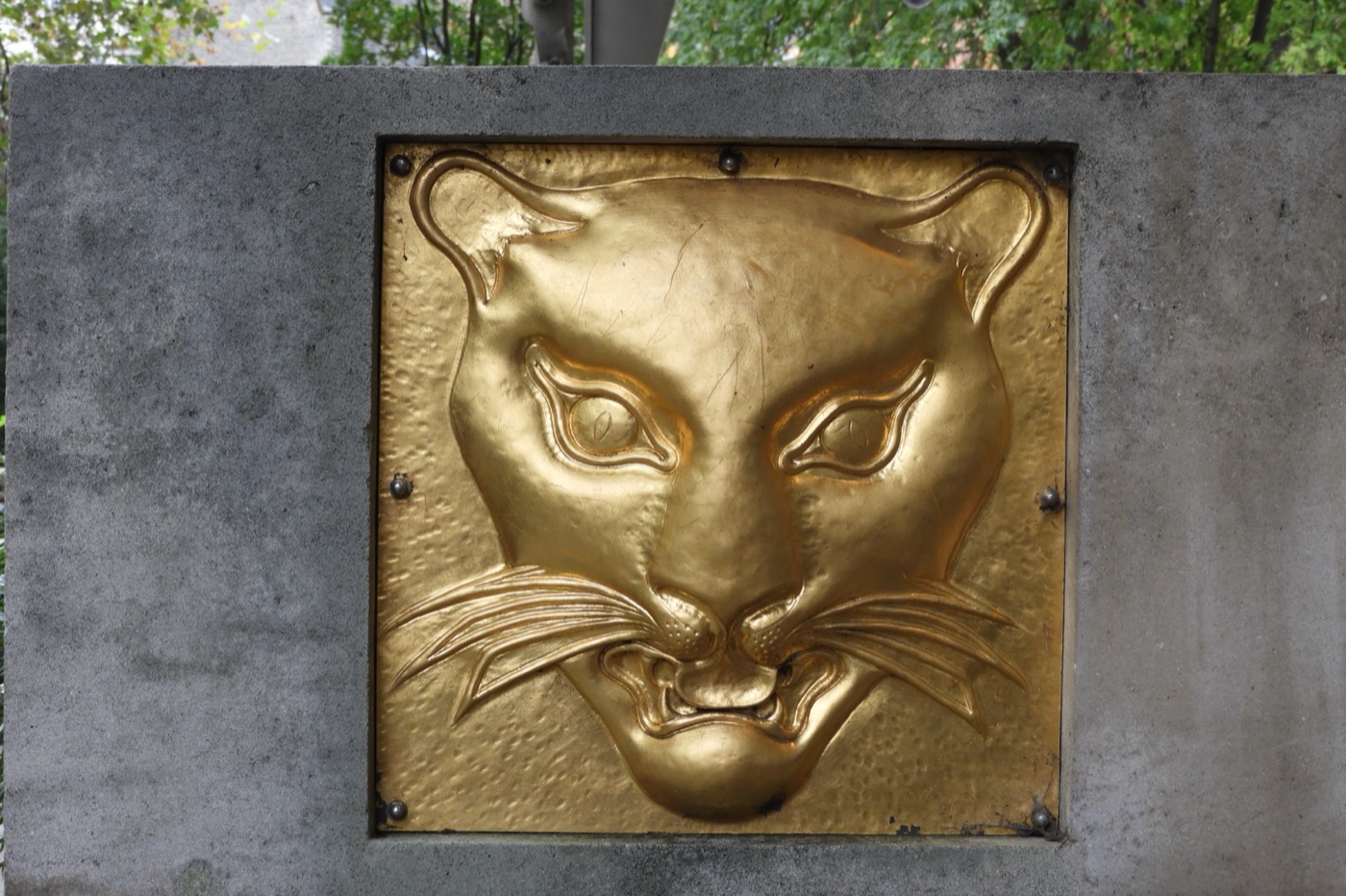
Photo: GrimsbyT / Wikimedia Commons / CC BY-SA 4.0

How do you decode the date letter?
The date letter runs through a 20 to 25-letter alphabet in cycles, with every cycle using a distinct font and shield shape so the same letter in different centuries can’t be confused. London added the date letter in 1478, making it the second-oldest element of the hallmark (Goldsmiths’ Company Assay Office, n.d.). By the time you’re reading an 18th or 19th century piece, there are roughly fifteen overlapping cycles to choose from.
The letter J is almost always skipped because in traditional blackletter and roman fonts it’s too easily confused with I. Most London cycles run A–U (20 letters), Birmingham and Sheffield run A–Z (25 letters), and Edinburgh varies by period. The font might be roman, italic, blackletter, copperplate, uncial, or gothic; the shield might be square, round, pointed, or cusped.
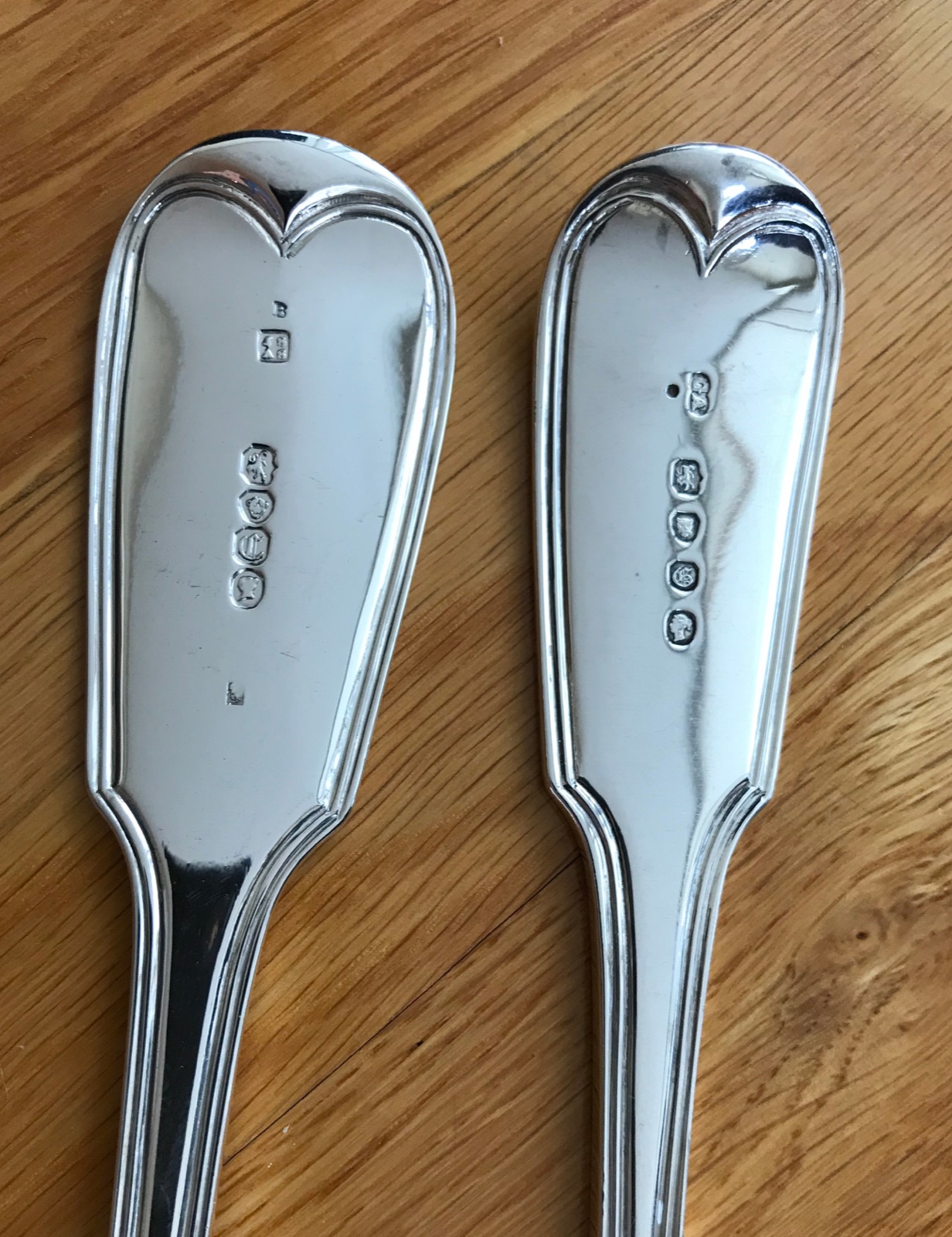
Photo: Grenadille / Wikimedia Commons / CC BY-SA 4.0
_silver_hallmarks_(with_Tally_Mark).jpg)
You don’t memorise the cycles — you look them up. The standard reference is Jackson’s English Goldsmiths and Their Marks, first published in 1905 and still in print. Online, the Birmingham Assay Office’s date-letter tool and the London office’s charts are both free and authoritative. Match the letter shape, the font, and the shield simultaneously — getting two out of three isn’t enough.
Here’s a live example of how often this comes up. In 2025, Birmingham and London both rolled their cycle from Z (2024) back to A (2025) (Birmingham Assay Office, 2025). Which means a Birmingham-marked piece with an A in the current cusped shield is from 2025 or 2026. The same A in a pointed shield with a serif font is 1775–1776. Same letter, 250 years apart. The shield is the tell.
What does the standard mark tell you about purity?
The standard mark is the purity guarantee. In Britain it’s almost always the lion passant — a walking lion in profile, struck on sterling silver since 1544 (Goldsmiths’ Company Assay Office, n.d.). If you see a walking lion on British silver, the piece is at least 92.5% pure. Scottish silver uses a lion rampant (standing on hind legs) or historically a thistle. Britannia standard (95.84%) is marked with a seated figure of Britannia — mandated 1697–1720 to stop silversmiths melting down sterling coinage, still legal today.
The lion passant is actually the second-oldest mark in the system. It was added to London silver in 1544 under Henry VIII, specifically because the king had been debasing his own coinage and needed a way to reassure the public that at least their silver plate was still the real thing. The irony is perfect. The mark that now stands for 500 years of integrity was invented to cover for a king cheating on his own currency.
A quick visual sanity check: sterling items struck with a lion passant guardant (lion looking over its shoulder at the viewer) are 1544–1822. From 1822 onwards the lion looks forward, in profile. On Scottish silver, Edinburgh switched from a thistle to a lion rampant in 1975, which is why modern Scottish sterling carries a different standard mark from modern English sterling — same purity, different heraldry.
How do American, French, and other hallmarks differ?
The American system is the simplest and the most frustrating. Most 19th and 20th century American silver carries only a maker’s mark plus the word STERLING or the number 925 — no town mark, no date letter, no duty mark. “Sterling” became the dominant standard in the US around 1868, replacing the older COIN standard (90% pure). Which means you can often date a piece to before or after 1868, but not much more precisely than that without digging into factory archives.
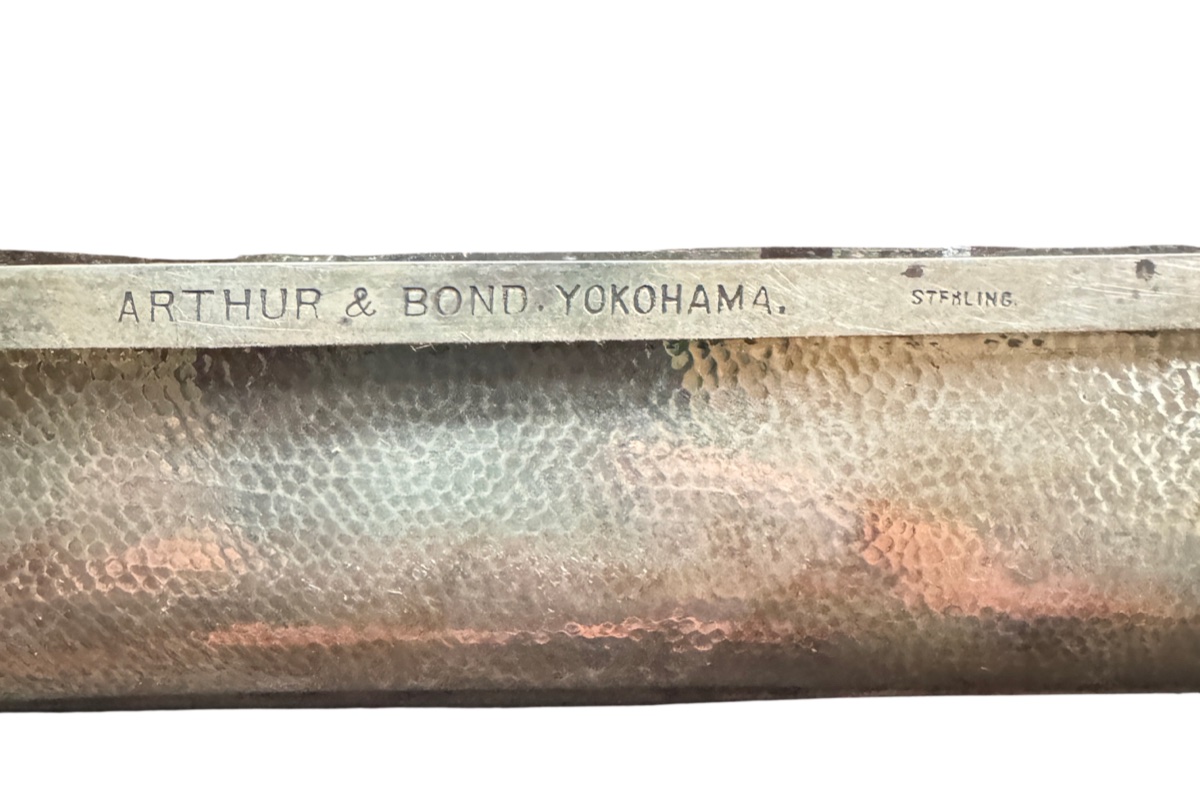
Photo: The St. James’s Collection / Wikimedia Commons / CC BY-SA 4.0

The big American makers are identifiable by their wordmarks or logos. Tiffany & Co. uses a stamped TIFFANY & CO. wordmark, sometimes with pattern numbers. Gorham uses a lion, an anchor, and a Gothic G — a deliberate nod to British hallmarks. Reed & Barton, Towle, International, Stieff, Kirk — each has a distinct stamp, and each keeps archives you can match against. The Silver Magazine and online maker databases are the reference. Don’t trust a piece marked only “925” with no maker — that’s usually a cue for modern import jewellery.
The French system goes the other way: more stamps, more symbols, less ambiguity. Since 1838, French silver above 30 grams carries a Minerva head for 1st standard (950/1000) or a crab for 2nd standard (800/1000). Smaller items use a boar’s head (Paris) or a crayfish (provincial). Import silver carries a swan or a duck. Each has a numeric indicator inside the cartouche pointing to the exact assay office.
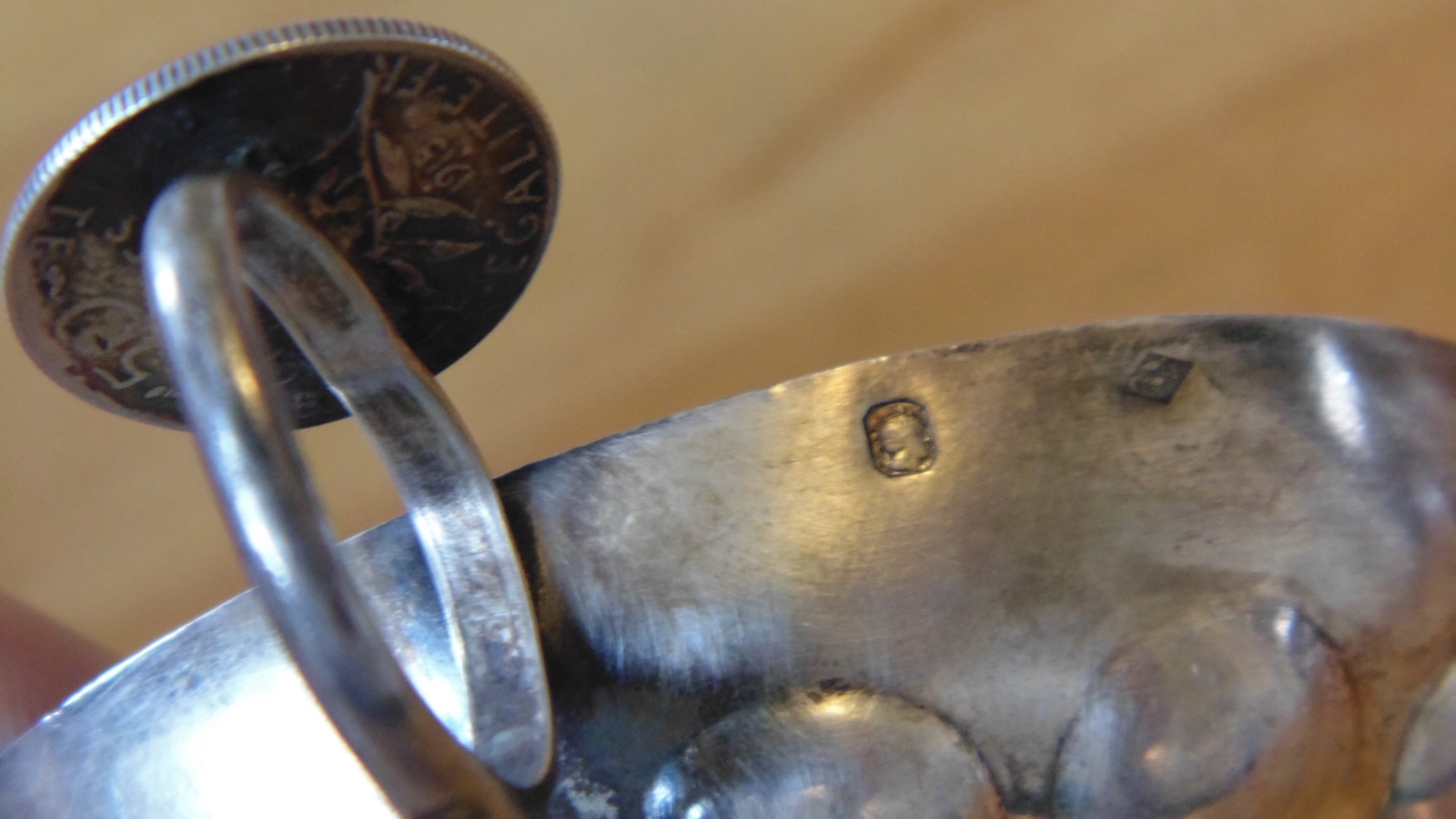
Photo: Copyleft / Wikimedia Commons / CC BY-SA 4.0

The rest of Europe is a patchwork. Germany mandated the crescent moon and crown (Halbmond und Krone) plus a three-digit purity number (800, 835, 925) in 1888. Dutch silver uses a lion passant for 934 and a lion rampant for 835, plus city marks like Amsterdam’s three crosses. Italian silver uses a star with a number (the “fascio” mark was dropped after 1944). Russian imperial silver, including Fabergé, carries a zolotnik purity mark (84 zolotnik = 875/1000) plus the initials of the assayer and the city. After 1958, nearly every European country converged on ISO 9202 — but anything pre-war follows the old national systems.
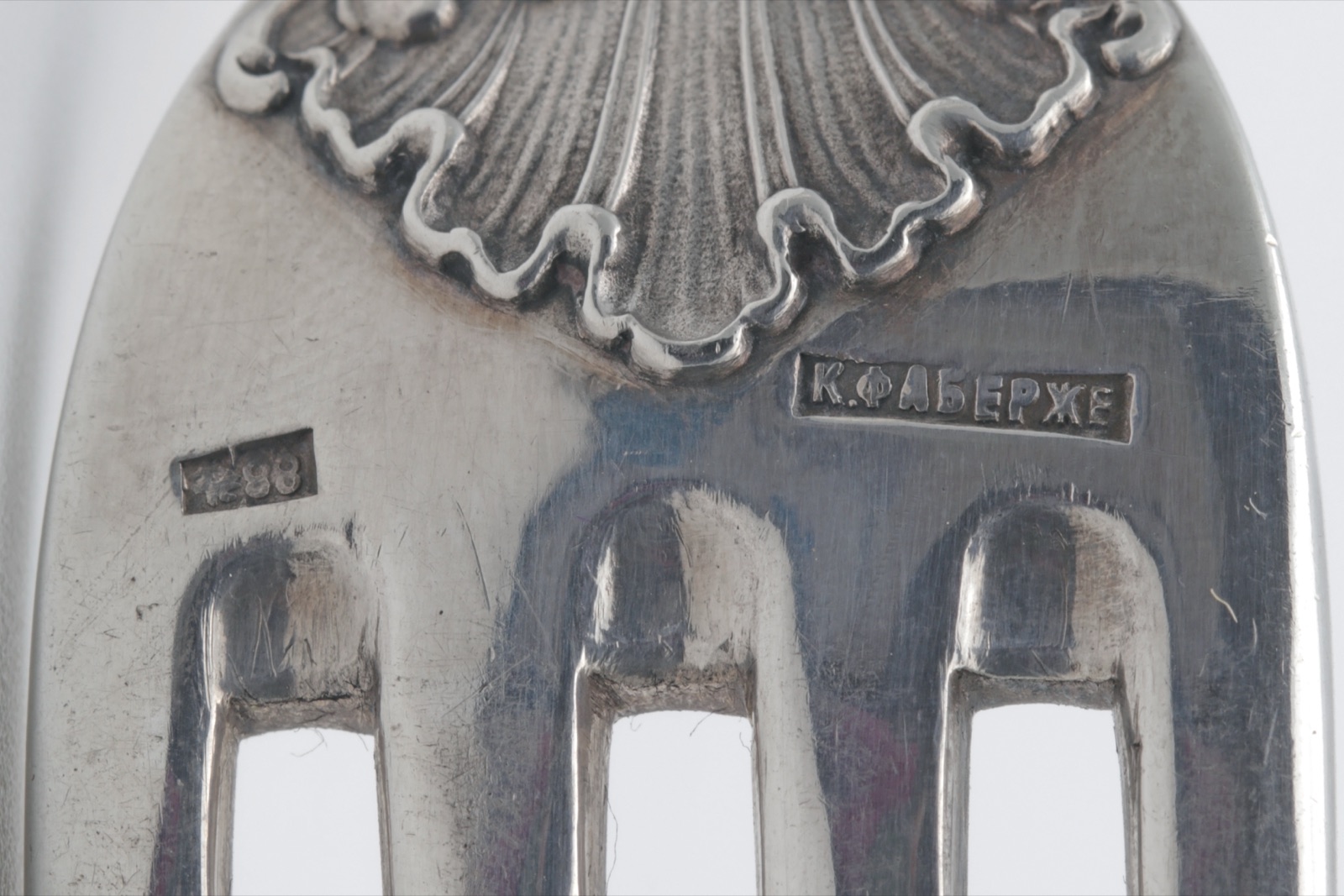
Photo: Charles J. Sharp / Wikimedia Commons / CC BY-SA 4.0

What are the signs of a fake or plated piece?
Silver plate is not an attempt to deceive. It’s a legitimate product category, legally marked since the 19th century. The problem is when plated items get sold as solid silver either through ignorance or deliberate misrepresentation. With silver at $79–$82 per troy ounce in April 2026 (LBMA via SD Bullion, 2026), the incentive to blur that line has never been higher. The price is roughly triple where it sat five years ago.
The clearest indicators of plating are the abbreviations. EPNS means electroplated nickel silver — a nickel base plated with a thin layer of silver. EPBM is electroplated Britannia metal. A1 indicates a premium plating thickness, not solid silver. Sheffield Plate is a fused-sheet process from the 1740s onward, collectable in its own right but worth perhaps 10% of sterling. Silver on Copper is self-explanatory. Any of these stamps rules out sterling immediately.
Harder to catch are the cases where a piece is marked only with a maker’s name and nothing else. Reed & Barton, Rogers Brothers, Oneida, and Community all made both solid sterling and silver plate in massive quantities, and the only way to tell them apart is the presence or absence of STERLING or 925 on the piece. If you see Oneida with no purity mark, assume plate. Same for Rogers. The sterling lines always carry the sterling mark.
Enforcement is real. In November 2025, Hull City Council Trading Standards prosecuted a jeweller for selling unhallmarked silver rings misrepresented as sterling (Hull City Council, 2025), resulting in fines above £4,000. The same month, a Bethnal Green jeweller was convicted under the Hallmarking Act 1973 and fined over £7,000 for illegal gold and silver sales (East London Advertiser, 2025). The Act allows fines of up to £5,000 per unhallmarked article.
A two-minute physical test catches most fraud before you even need the marks. Silver isn’t magnetic — if a piece sticks to a magnet, it contains iron, steel, or nickel and is not solid sterling. Silver feels heavier than its volume suggests (density 10.49 g/cm³). Real silver tarnishes black over time; nickel plate goes a yellowy grey. And sterling makes a long, clear ringing sound when tapped against another piece of sterling; plated metal thuds. None of these replace the marks, but they’re free sanity checks.
How much does a maker’s mark change the value?
More than any other single element. An unmarked sterling tea set with forty troy ounces of silver is worth roughly its melt value — about $3,160 at $79/oz. The same set, clearly marked Paul Storr, can bring $10,000 to $25,000 at auction depending on form and condition. The metal is identical. The difference is the mark.
The other mark that shifts value is the duty mark, specifically when it’s absent from pieces that should have one. Items made in Britain between 1784 and 1890 that don’t carry a sovereign’s head either never went through assay (illegal at the time and suspicious now) or have been altered. Authentic sovereign’s heads follow a known sequence — George III (1784–1820), George IV (1820–1830), William IV (1830–1837), Victoria (1837–1890, incuse from 1890). Mismatching a duty mark to the reign is one of the easier fakes to catch.
How do you read any hallmark in 60 seconds?
Once you know the pieces, the pattern matching is fast. The procedure that auction cataloguers use — and the one you can reproduce in a minute or two at a flea market — goes like this:
Step 1. Find the marks. Underside, base, back of the stem, inside the lid. Use good light and a 10x loupe if you have one — silver marks are often worn. If you find no marks at all, stop here. Assume plated or unidentified until further work.
Step 2. Identify the standard mark. Walking lion (British sterling 925). Britannia figure (British Britannia 958). Number 925 or word STERLING (international sterling). Minerva head (French 950). Crescent and crown with number (German). No standard mark means either very old, very small (under the exemption threshold), or not solid silver.
Step 3. Identify the town or country mark. Leopard head (London), anchor (Birmingham), rose (Sheffield), castle (Edinburgh). Hibernia (Dublin). If you can’t identify a town mark and the piece is British, it’s likely from a closed office (Chester, Exeter, Glasgow) or a provincial mark.
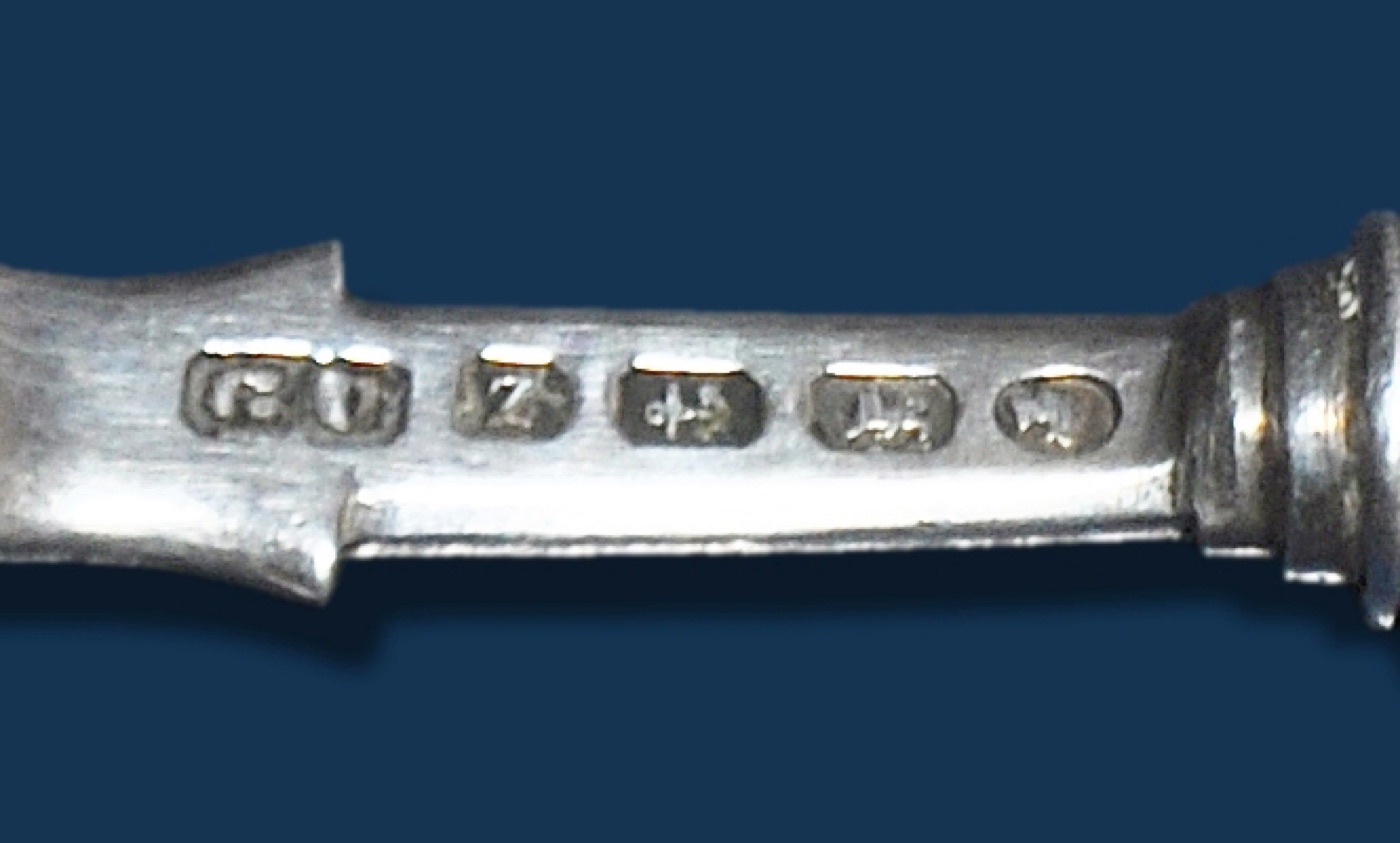
Photo: Jojorei / Wikimedia Commons / CC BY-SA 2.0
.jpg)
Step 4. Read the date letter. Letter shape plus font plus shield shape. Look it up against the assay office’s cycle chart. Two out of three isn’t enough — all three have to match.
Step 5. Identify the maker’s mark. Initials in a shield, or a full name. Cross-reference against Jackson’s, the assay office database, or a specialist like the 925-1000 reference site. For American silver the maker’s mark is often the whole game — the wordmark dates and attributes the piece on its own.
Step 6. If present, verify the duty mark. Sovereign’s head should match the reign implied by the date letter. A William IV head on an 1840 piece is wrong. A Victoria head on a 1780 piece is impossibly wrong. This is your fraud check.
Six steps, a minute or two, and you have a reasonable attribution. Not a certified appraisal, but enough to tell you whether to walk away from a dealer’s counter or pull out your phone and start negotiating.
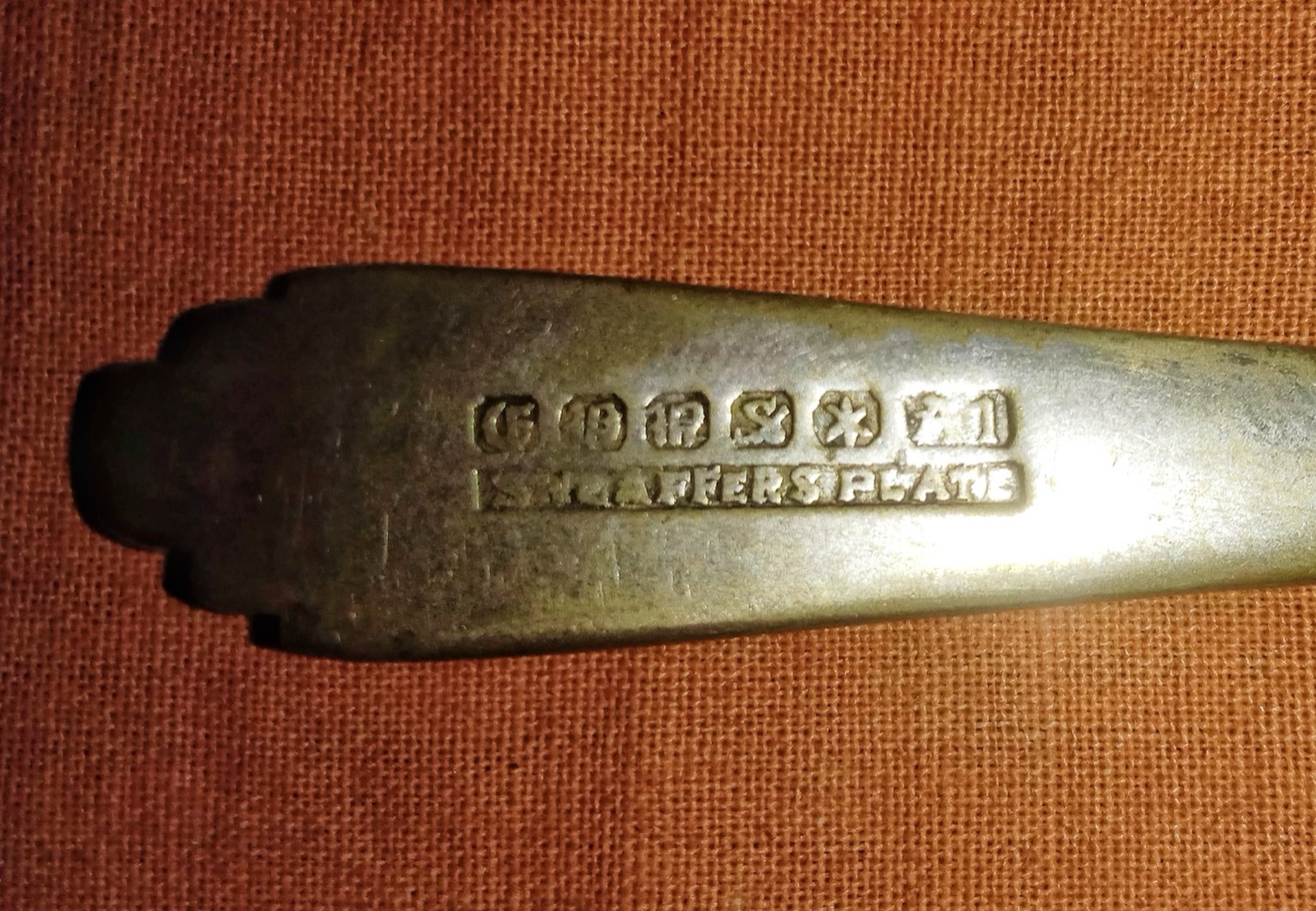
Photo: Billjones94 / Wikimedia Commons / CC0 (Public Domain)

The bottom line
Silver hallmarks are the single most compressed piece of information in the antiques world. Four or five stamps, each the size of a pinhead, tell you purity, origin, age, and maker — everything you need to move from maybe-silver to a specific attribution with a market value attached.
The system isn’t perfect. Marks wear off. Fonts overlap between centuries. Provincial pieces from closed assay offices take research. American silver skips most of the date information. And silver plate marked with a respectable-looking maker name can easily be mistaken for sterling by anyone who doesn’t know the abbreviations. But the system works, and has for 725 years, which is why the British hallmark is still the single most trusted quality stamp on any consumer good in the world.
With silver at $79–$82 per troy ounce, the grandmother’s tray in the opening paragraph — 18 troy ounces of sterling, Hester Bateman attribution — is worth roughly $1,400 in melt and somewhere between $3,500 and $8,000 to the right collector. You don’t need to be a trained appraiser to get to that answer. You just need to read the marks.
Frequently asked questions
What are the four marks on antique British silver?
A full British hallmark has four required marks: the maker’s (or sponsor’s) mark showing the silversmith’s initials, the standard mark showing purity (a lion passant for sterling 925 or a figure of Britannia for 958), the town mark showing where the piece was assayed (a leopard’s head for London, an anchor for Birmingham, a rose for Sheffield, a castle for Edinburgh), and a date letter showing the year. Items made between 1784 and 1890 also carry a duty mark — the sovereign’s head in profile — indicating tax was paid.
How do I tell sterling silver from silver plate?
Look for marks. Sterling carries a hallmark or the number 925. Silver plate is stamped with abbreviations like EPNS (electroplated nickel silver), EPBM (electroplated Britannia metal), A1, triple plate, or Sheffield plate. If a piece is marked only with a maker’s name and no purity stamp at all, assume plated until proven otherwise. A magnet test helps too — silver isn’t magnetic. If the piece sticks to a magnet, it contains iron or nickel and isn’t solid silver.
What does a number like 925, 800, or 958 mean on silver?
Those are millesimal fineness marks showing purity in parts per thousand. 925 is sterling (92.5% silver). 958 is Britannia (95.84%, mandated in Britain 1697–1720 and still legal). 900 is American coin silver. 950 is French 1st standard, marked with a Minerva head. 800 and 835 are common European standards used in Germany, Scandinavia, and the Netherlands. Items below 800 are technically silver but rarely classed as fine silver.
How do I find the year an antique silver piece was made?
On British silver, find the date letter, which runs through the alphabet in 20 to 25-year cycles with a different font and shield shape for each cycle. Match the letter, font, and shield against a date letter reference for the assay office in question (London, Birmingham, Sheffield, or Edinburgh). American silver rarely has a date letter, so dating relies on the maker’s mark style and factory records. French silver carries assay marks with traceable symbols tied to decade ranges. AI identification apps like Circa can shortcut the lookup by photographing the full hallmark set.
How much is an unmarked silver piece worth compared to a marked one?
Unmarked sterling usually sells near melt value, while the same piece from a named maker can sell for three to ten times more. With silver at $79 per troy ounce in April 2026 (LBMA, 2026), a 40-ounce unmarked tea set is worth about $3,000 in melt. The same set marked by Paul Storr or Tiffany could bring $10,000 to $25,000 at auction depending on condition, period, and form.
Catherine Hartley is a certified appraiser (ISA) and antiques market analyst with 15 years of experience in estate valuation. She has appraised collections for auction houses across the Northeast and writes about pricing trends for collectors and inheritors.